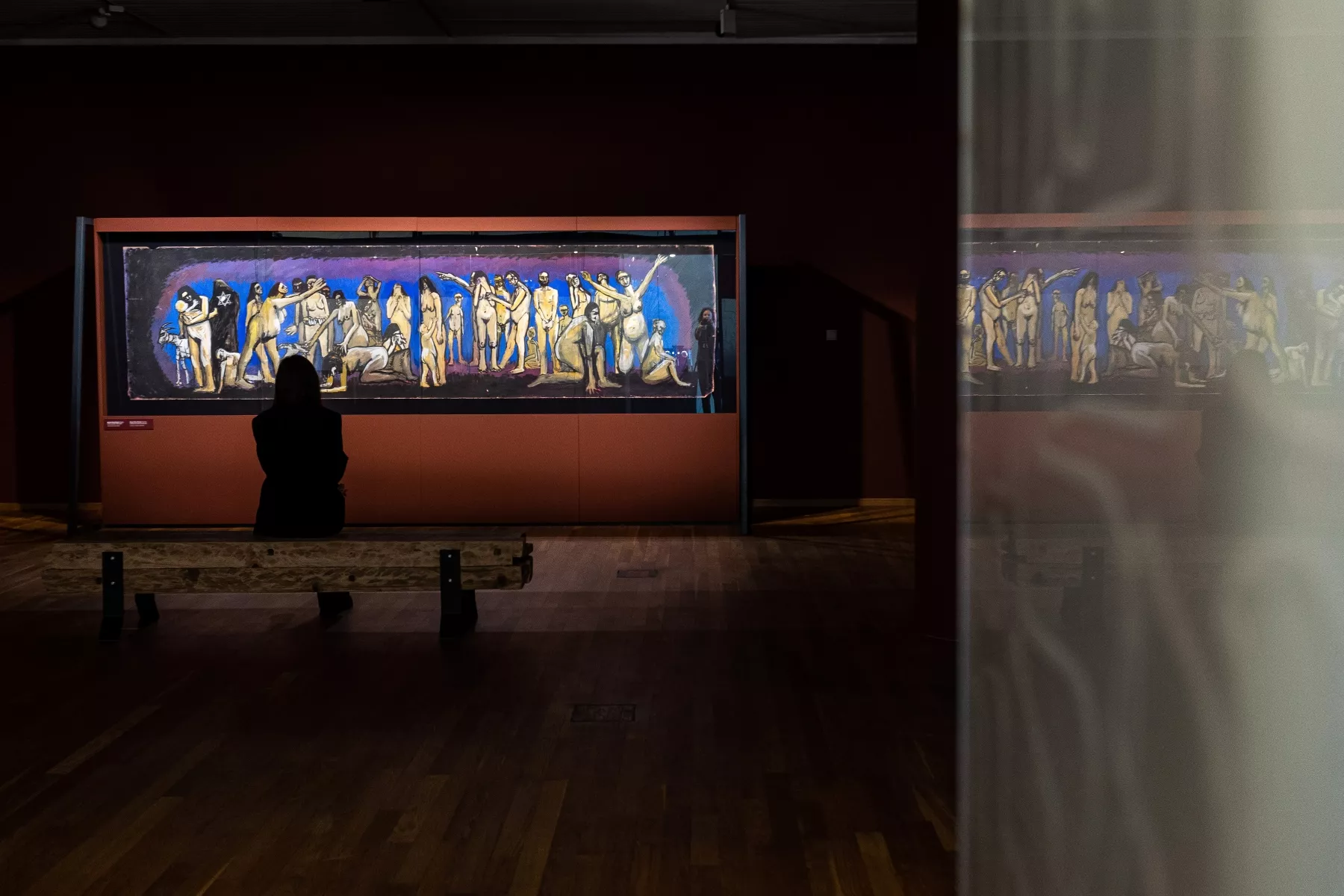
We are presenting for the first time Marek Oberländer’s work titled "Ghetto" (1955) – a monumental composition which has not been presented to the public for over 70 years.



- Photo: M. Starowieyska / Museum of the History of Polish Jews
- Photo: M. Starowieyska / Museum of the History of Polish Jews
- Photo: M. Starowieyska / Museum of the History of Polish Jews
- The frieze titled "Ghetto" by Marek Oberländer
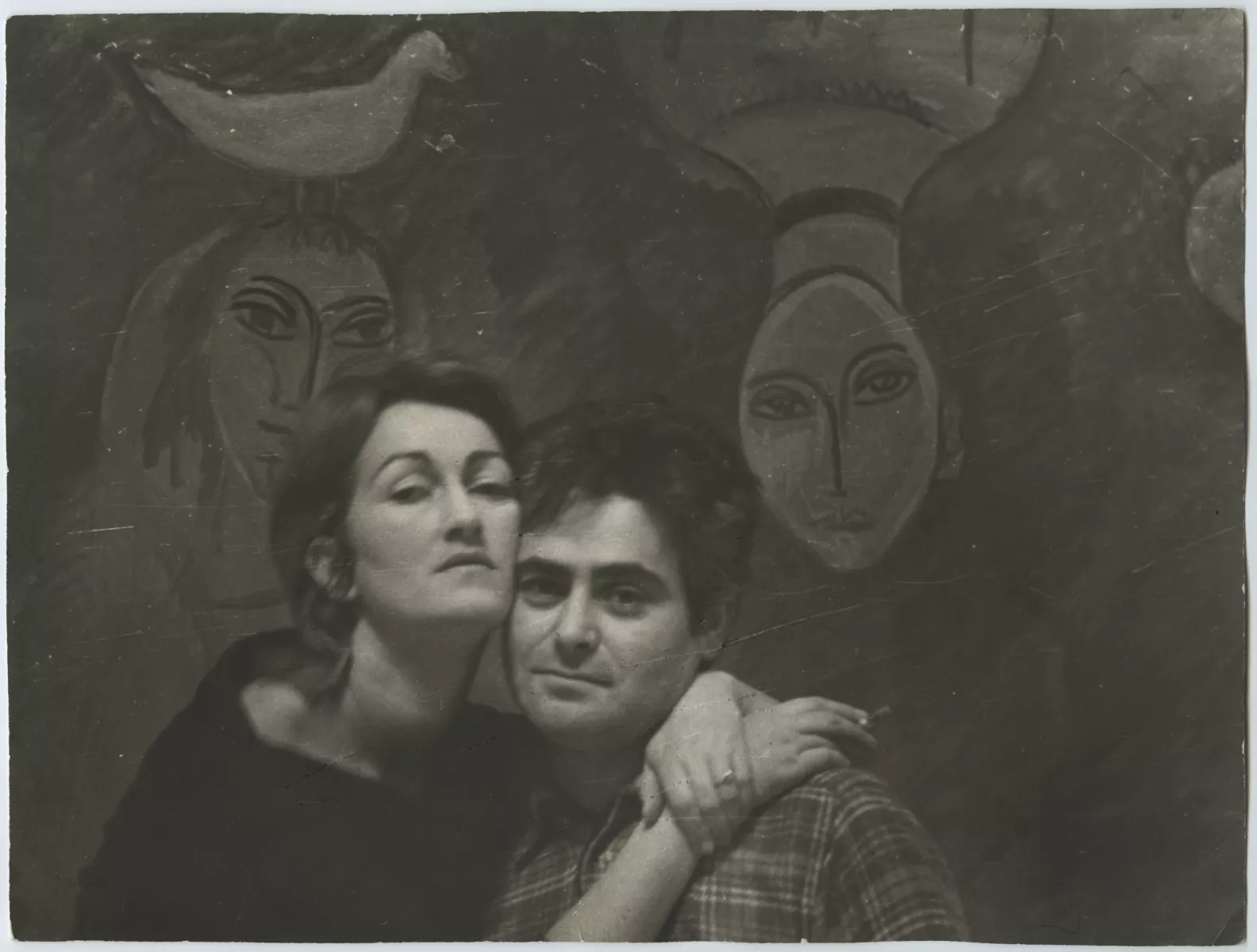
- Marek Oberländer with his wife Halina in their studio on Solna Street. In the background, "A Dream of Goldfaden." Photo: Emigration Archives, University Library of Toruń
The frieze remained largely unknown to the wider public. Now, for the first time since its creation, it will be presented at POLIN Museum. Due to the fragility of Oberländer’s work, it will be available for viewing for only two months.
Marek Oberländer did not share his experiences from the Second World War. His friend Bohdan Czeszko wrote:
He kept it all away under lock and key.
What he was unable to articulate with words, he encapsulated in a composition that is over four meters long. Dr Natalia Romik, curator of ‘A Frame of Suffering’ special presentation, compares Oberländer’s work to Pablo Picasso’s Guernica, citing both its scale and its mode of representing collective experience.
The frieze was executed in ink and gouache (opaque water-based paint) on cardboard. It depicts nude figures in gestures of despair, rendered in intense, powerful colors. For centuries, the frieze form has been used to narrate momentous and tragic events; here, it is employed to convey the experience of the Holocaust as a visual testimony inscribed in the image.
The presentation will be accompanied by an online discussion panel – a video podcast titled ‘A Frame of Suffering.’ The invited experts will reflect upon, i.a., ways of depicting the Holocaust experience in visual arts.
The "Ghetto" frieze comes from the collection of art historian and collector Krystyna Czartoryska. It has been deposited at POLIN Museum.
Marek Oberlander. ‘A Frame of Suffering’
- Curator: Dr Natalia Romik
- Exhibition design: Piotr Jakoweńko, Sebastian Kucharuk
- Exhibition coordinator: Anna Rechentiuk-Tyszka
- Exhibition production: IKG Aleksander Sieklicki
- Head of POLIN Exhibition Department: Joanna Fikus
- Registrars: Aneta Jasionek, Aniela Mikuła
- Conservation: Agnieszka Cyrulik, Weronika Gąsior, Erika Krzyczkowska-Roman
- Exhibition text by: Piotr Rogacz
- Proofreading of Polish: Marta Markowska
- Translation: Zofia Sochańska
- Promotion: Olga Kaliszewska, Karolina Kuta, Nina Nowakowska
- Exhibition poster design: Rafał Grunt
Marek Oberländer was born in 1922 into a large Jewish family in Szczerzec near Lvov. After the outbreak of the Second World War, he found himself in the territories under Soviet occupation, and was conscripted into the Red Army. He was later sent to a labor camp deep in the Soviet Union. He was the only member of his family to survive the war. Upon returning to Poland, he searched futilely for his relatives, who had fallen victim of the liquidation of the ghettos and the extermination camps. Oberländer stayed in postwar Poland, and began studying painting at the Academy of Fine Arts in Warsaw.
The theme of the Holocaust appeared in his art as early as the beginning of the 1950s. The artist addressed it, among others, in the painting "Hunger in the Ghetto" (1953) and in the series of prints "Never Again the Ghetto" (1954). Oberländer was also one of the initiators of the famed exhibition of young artists titled "Against War, Against Fascism," held at Warsaw’s Arsenal in 1955. His painting "Branded" became one of the most widely discussed works at this exhibition as it represented a powerful voice of a generation opposing the postwar restrictions imposed on art.
Oberländer’s work was deeply rooted in his personal experience of the War and the loss of loved ones. The artist repeatedly returned to the memory of the victims and to attempts to understand the human condition after the tragedy.
Presentation is part of the Warsaw Ghetto Uprising Campaign which commemorates the Warsaw Ghetto Uprising.
‘A Frame of Suffering’ – a special presentation of Marek Oberländer’s "Ghetto"
13.04.2026 - 15.06.2026
Ground floor of POLIN Museum (level 0), exhibition room behind the Austeria bookstore
Free admission