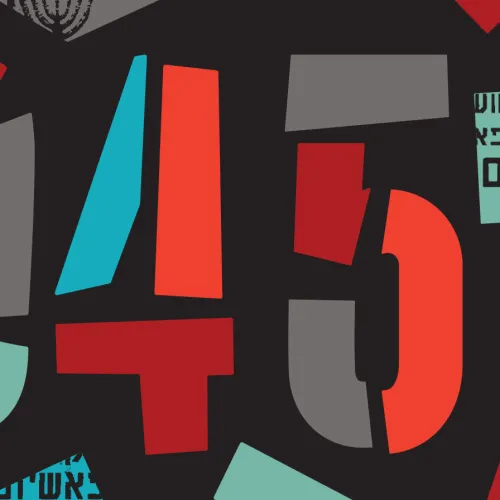
"19482025~im~possible~pavilion" is a performative ceremonial intervention into the "Closure" section in the "1945. Not the End, Not the Beginning" exhibition. The performative ceremony is a gesture of return to the Jewish Pavilion in the Recovered Territories exhibition, a project that had been halted just before it was ready to begin.

After 1945, tens of thousands of Jews settled in Lower Silesia – at its peak, the Jewish community in this region totaled around 100,000. They created their own communities and care systems, made sure that there was bread for the hungry, work for the working hands and theater and art for the wounded souls of the survivors from the death camps and hiding places. Most of them were not planning to emigrate again; they built a new Jewish life on the ruins of postwar Poland.
In the spring of 1948, at the same time as the declaration of the State of Israel in Palestine and the beginning of what would become the Nakba (lit. "catastrophe") of Palestine, the Jewish pavilion that was to present the achievements of the Jewish cooperatives in Lower Silesia was cancelled by the delegates of the communist administration. Paradoxically, this may have been in line with the expectations of Zionist organizations, which argued that the continued existence of Jews as a community in Poland was impossible or at least undesirable. And that leads to the question: what was the actual reason for the last-minute closure of the pavilion, when the growing pressure to force migration to Palestine is well documented and described? This history is rarely told, as it is not in line with the contemporary ethnonationalist narratives—the language of power, separation, and domination.
The very thought of a possible existence of large Jewish communities in Poland – ones that could have been rooted in a thousand-year history of cohabitation rather than settler colonialism – is an act of resistance. For that, we return to the symbolic moment that was prevented from happening — the opening of the Jewish pavilion in the Lower Silesia exhibition in 1948.
The 19482025~im~possible~pavilion performative action invites the audience to gather around this ~im~possible moment and let it revive through body memories and the act of care. We want to reconnect with those possibilities and allow them to affect our actions in the current, violent existence.
This is an invitation to take a pause as an act of resistance, and take part in a historical moment that never happened, reimagine together, and explore it further with the question:
– What if…?
Hagar Ophir
Please note
that the performance will be mostly in Polish. Non-Polish speakers are welcome to attend, bearing this information in mind.
Credits
- Concept, research, choreography, text and direction: Hagar Ophir
- Dramatic structure, text and choreography collaboration: Hana Umeda
- Sound: Miriam Schickler
- Performance and choreography collaboration: Katarzyna Sikora
- Curator: Ewa Chomicka
- Production: Alicja Kaczmarek-Poławska
- Research collaboration: Dr. Marek Szajda
Hagar Ophir was born in Jerusalem in Her work establishes history as a space to imagine and actualize possible presents, using historical research, textile, drawing, performance, and collaborations. Recent projects include two solo exhibitions, "Bound with the Living The Archive Room" (Diffrakt, 2024) and "Recalling History Bundled with the Living" (Soma Art, 2023), as well as "Letter of Demand" ("Taboo" group exhibition, 2023). In 2020-21, as a co-founder of mitkollektiv, Ophir co-directed the art education project "Reimagine Jetzt!". Her illustrations appear in the children's book "Golden Threads" (A.A.Azoulay, Ayin press, 2025). Currently, she is a holder of an artist research grant from Gwaertler Stiftung. In 2016, Ophir immigrated to Berlin as part of an ongoing attempt to reclaim Jewish diasporic existence.
Hana Umeda (a.k.a. Sada Hanasaki) is a Polish-Jewish-Japanese artist based in Berlin/Warsaw. She is a rebellious jiutamai dancer of Hanasaki-ryu. Her artistic practice is body-based, sliding between the intersections of choreography, performance, theater, and visual arts.
Katarzyna Sikora is a dancer and performer working primarily in the field of new choreography. She also works as a choreographer and movement consultant in theater productions, music videos, and short films.
Support:
Promotional photograph: Moritz Gansen, documentation of Hagar Ophir’s work "Bound With the Living: The Archive Room"
19482025~im~possible~pavilion
7 PM
15.09.2025 - 15.09.2025
Exhibition space: "1945. Not the End, Not the Beginning"
Admission with free tickets