Conference launching "Polin: Studies in Polish Jewry," volume 38 will consist of two online panels (zoom) starting at 12:30 pm in the afternoon with presentations by authors and editors, and an evening in-person session at UCL, at 6 pm. The in-person event will introduce the volume, followed by a keynote lecture and a reception. Its venue will be shared after registration.
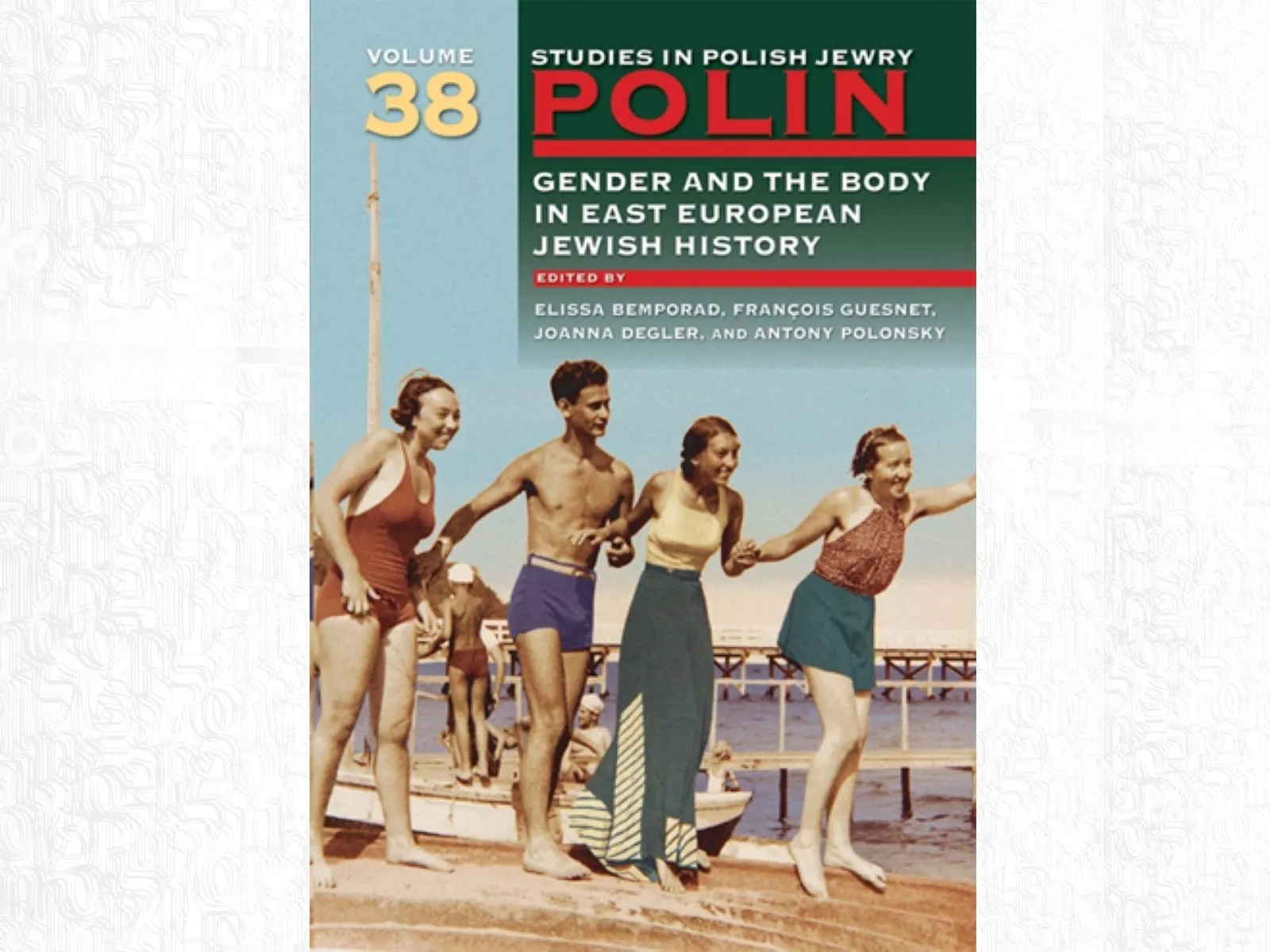
The most recent volume of Polin. Studies in Polish Jewry explores the impact of religious and esoteric traditions around the body, gender and sexuality including fasting, libido, possession, and demonic interference. How was the Jewish body was construed in fiction, ego-documents and (queer) poetry? How did Jewish youth think about sport, how impersonating diverse identities during the Second World War became a matter of survival?
It engages with concerns such as the panic over "White Slavery," gender-dependent perceptions of warfare, care for the elderly, and birth control. It reflects on the subversion of established roles of perpetrator and victim in the context of pogrom violence, the plunder of Jewish clothes during the Holocaust, and how the mass graves of the murdered Jews perpetuated a Jewish presence after the genocide.
Organisational information
- Monday, 23 March 2026 12:30 PM GMT/ 1:30 PM CET/ 2:30 PM Israel/ 7:30 AM EDT (online); 6:00 PM GMT (in person in London)
- Registration for online sessions is mandatory
- Registration for in-person event is mandatory
Conference programme
Panel 1 (online) 13:30
Chair: François Guesnet
Aleksandra Jakubczak
Marriage as Froyen-handl: Jewish Marital Practices in the Early Twentieth Century
Aleksandra Jakubczak is a scholar specializing in the social and economic history of East European Jewry in the 19th and 20th centuries, focusing on women, gender, migration, and transnationalism. In 2023 she received her PhD from Columbia University and, in 2024, was a postdoctoral fellow at the Center for Jewish Studies at Harvard University. Since 2022, she has been working as a historian at POLIN Museum of the History of Polish Jews in Warsaw.
Szymon Beniuk
Defining Jewish Boyhood and Girlhood through Sport in Interwar Poland: Mały Przegląd as a Mirror of Gendered Sporting Discourses
Szymon Beniuk is assistant professor at the Institute of History, University of Wrocław. His research focuses on the material and social history of sport in the twentieth century, particularly interwar sports infrastructure, spectator behaviour, and sport among national minorities. He has examined Jewish sport, including Hakoah Vienna’s 1920s tour of Poland and Jewish youth sport as reflected in "Mały Przegląd," initiated by Janusz Korczak. He has published in Polish academic journals and edited volumes and is currently preparing a monograph on football fandom in interwar Poland.
Magdalena Waligórska
The Theft of Jewish Clothes During the Holocaust
Magdalena Waligórska is currently based at the Department of Ethnology of the Humboldt University in Berlin, leading an ERC research group studying genocidal dispossession in Eastern Europe. She is the author of "Klezmer’s Afterlife: An Ethnography of the Jewish Music Revival in Poland and Germany" (Oxford University Press, 2013) and "Cross Purposes: Catholicism and the Political Imagination in Poland" (Cambridge University Press, 2023), which was awarded the 2024 Bronisław Malinowski Social Sciences Award from PIASA.
Panel 2 (online) 15:30
Chair: Elissa Bemporad
Samuel Glauber
Demons, Dybbuks, and a Water Medium: Possession in Early Twentieth-Century Warsaw
Samuel Glauber is the Miriam Barr Librarian for Jewish & Near Eastern Studies at Washington University in St. Louis. A scholar of modern Judaism specializing in East European Jewry and its diaspora communities, he is currently completing a PhD in the Department of Jewish Thought at Ben-Gurion University of the Negev, where he is writing a dissertation exploring Jewish engagement with modern occult currents in late-nineteenth- and early-twentieth century Eastern Europe.
Mayhill Fowler
Dina Pronicheva and the Embodied Experience of War: New Perspectives on Theatre in Ukraine
Mayhill C. Fowler is Professor of History at Stetson University and affiliated faculty in the Program in Theater Studies at Ivan Franko National University of Lviv. She has published widely on culture in Ukraine, including her book Beau Monde on Empire's Edge: State and Stage in Soviet Ukraine (Toronto, 2017, and in Ukrainian by Rodovid 2025). She is currently working on a book on women in theater in Ukraine across the long 20th century, Theatre Women: Place and Performance in 20th Century Ukraine, as well as A Concise History of Ukraine with Sofia Dyak. She also holds an MFA in Acting from the National Theater Conservatory and is a former actress.
Anika Walke
Bodies in the Ground: Holocaust Mass Graves in Eastern Europe as Jewish Presence
Anika Walke is the Inaugural Askwith Family Chair of Holocaust Studies and Associate Professor of History at Carnegie Mellon University. Her book Pioneers and Partisans: An Oral History of Nazi Genocide in Belorussia (Oxford University Press, 2015) drew on oral history interviews, video testimony, archival documentation and various other sources to analyze how young Soviet Jews survived the Holocaust and made sense of it many decades later. She is currently working on a new monograph on the long aftermath of the Holocaust and of World War II in Belarus
Panel 3 (in person): 19:00
Chair: Antony Polonsky
Introduction: Antony Polonsky, François Guesnet
Keynote: Joanna Degler
Between Body and Spirit: Corporeality in Sarah Schenirer’s Early Diary
This lecture examines the role of the body in the early diary of Sarah Schenirer (1908–1913), written before she became the founder of the Beit Ya’akov movement. Drawing on the Polish-language diary, the talk explores how corporeality functioned as a site of tension between religion and modernity, obedience and rebellion, discipline and pleasure. Schenirer’s reflections on her own body reveal deep ambivalences: the body is simultaneously rejected and ritualized, disciplined and enjoyed, perceived as a source of suffering yet also as a means of self-formation.
The lecture argues that Schenirer’s struggle with corporeality was central to the development of her identity and leadership. Her rejection of both traditional models of Orthodox femininity and modern acculturated womanhood led her to articulate an alternative path based on education, religiosity, and female solidarity. By foregrounding the embodied dimension of Schenirer’s diary, the talk offers new insight into the gendered foundations of religious authority and female agency in early twentieth-century East European Jewish culture.
Joanna Degler (Lisek) is Associate Professor at the Taube Department of Jewish Studies (University of Wroclaw). Her research interests focus mainly on Jewish poetry and the role of women in Yiddish culture. She has published, among others: "Jung Wilne – żydowska grupa artystyczna" [Yung Vilne – A Jewish Artistic Group] (Wrocław 2005) and "Kol isze – głos kobiet w poezji jidysz" (od XVI w. do 1939 r.) [Kol Ishe - The Voice of Women in Yiddish Poetry from the 16th Century to 1939] (Sejny 2018). She has translated numerous texts from Yiddish to Polish, and edits the series "Żydzi-Polska-Autobiografia," including Sara Schenirer, "Being a Jewish woman is no small thing." Polish and Yiddish ego-documents (Polish), Warszawa 2024, edited by Joanna Degler and Dariusz Dekiert.
Response:
Elissa Bemporad
Professor of History and Chair in East European Jewish History and the Holocaust at Queens College and the Graduate Center – CUNY. She is a three-time winner of the National Jewish Book Award and is the author of three monographs, including "Legacy of Blood: Jews, Pogroms, and Ritual Murder in the Lands of the Soviets" (Oxford University Press, 2019), and Revolution, Civil War and New Ways of Life (NYU Press, 2025.) She is the editor of several volumes, including, most recently, "Pogroms: A Documentary History" (Oxford University Press, 2021) and "The Destruction of Dubova: Chronicle of a Dead City" (Bloomsbury 2025). Her work has appeared in different languages, including French, Hebrew, Yiddish, Italian, and Russian.
Conference Convenors:
François Guesnet
Professor of Modern Jewish History in the Department of Hebrew and Jewish Studies at University College London. He holds a PhD in Modern History from Albert-Ludwigs-Universität, Freiburg im Breisgau, and specializes in the early modern and 19th century history of Eastern European, and more specifically, Polish Jews. He has held research and teaching fellowships at the Hebrew University Jerusalem, the University of Pennsylvania (Philadelphia), the University of Oxford and Dartmouth College and is co-chair of the editorial board of "Polin: Studies in Polish Jewry."
Antony Polonsky
Chief Historian of the Global Educational Outreach Program, POLIN Museum of the History of Polish Jews, Warsaw and Emeritus Professor of Holocaust Studies at Brandeis University. He is co-chair of the editorial board of "Polin: Studies in Polish Jewry," and the author of many published works, the most recent being "The Jews in Poland and Russia," volume 1, 1350 to 1881; volume 2 1881 to 1914; volume 3 1914 to 2008 (2010, 2012), published in 2013 in an abridged version "The Jews in Poland and Russia. A Short History."
The conference is organized within the Global Education Outreach Program.
The conference is made possible with support from Taube Philanthropies, William K. Bowes, Jr. Foundation, Libitzky Family Foundation and the Association of the Jewish Historical Institute of Poland.