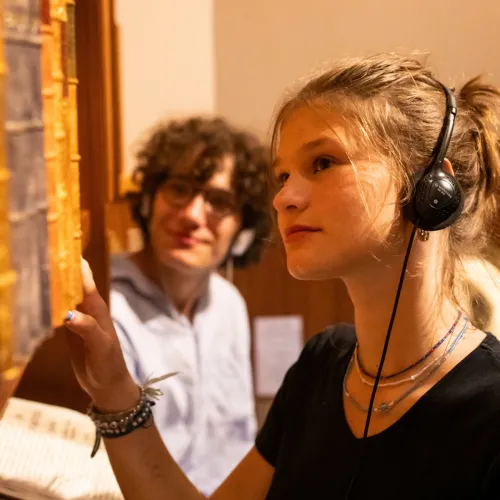
We invite you to take a journey through 1000 years of the history of Polish Jews. On the way, you will get acquainted with stories about exceptional people; about holidays, customs, religion and culture; stories of love, sacrifice and struggle, of the life known from chronicles and newspapers as well as the one known from Jewish towns and quarters.
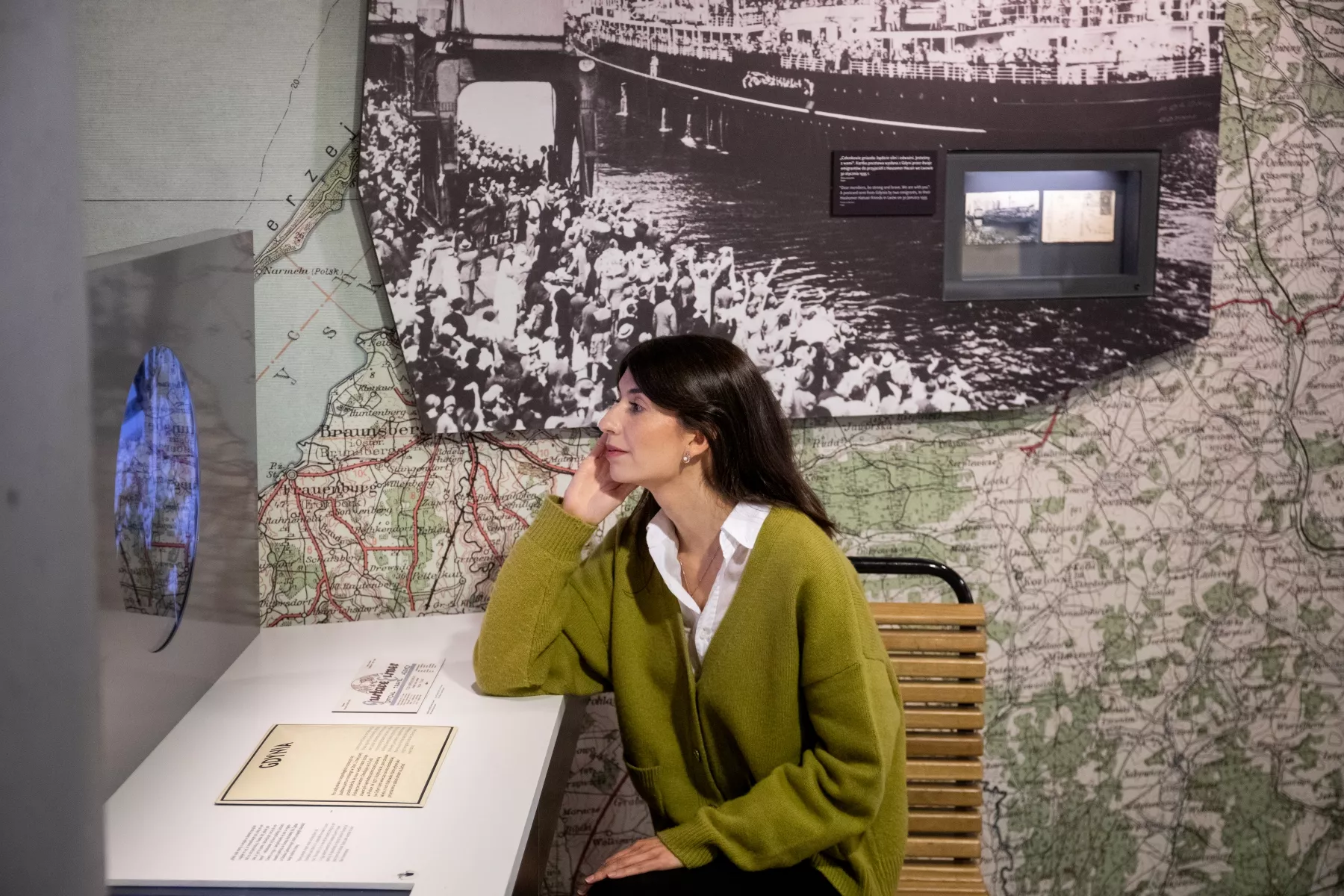


Photo: M. Jaźwiecki / Museum of the History of Polish Jews
Unique artifacts, reconstructions and multimedia will help you step into the world that is no more. Thanks to them, you will become part of this world for the duration of your visit.
The exhibition is divided into nine galleries. In them, we present the successive stages of the history—from the legends on the arrival of Jews in the Polish lands, through the development of culture, industry and commerce, to the time of the Holocaust and the present-day.
Get acquainted with the Core Exhibition’s galleries
Forest
According to the legend of the arrival of Jews in the country ruled by Duke Mieszko I, the word ‘polin’ marks the beginning of their 1000-year history in the Polish lands. In Hebrew, ‘po-lin’ means ‘here you will rest.’ It is also the Hebrew name for Poland. The legend will introduce you to the other galleries of the Core Exhibition.
Read more about the Forest gallery
One thousand years ago, a vast majority of the lands ruled by Duke Mieszko I were covered by thick forests, that is why we retell the legend in a symbolic forest, which the first Jews saw as a promise of shelter and a place to rest…
First Encounters (960–1500)
Where from did Jews arrive in Poland, where did they settle, and why there? In the 10th century, the Jews travelled across the Polish lands as merchants. 500 years later, they were already permanent residents here, settled in over 100 towns.
Read more about the First Encounters gallery
Find out how Jewish communities operated. Don’t miss the oldest object in the Core Exhibition—a 13th-century bracteate, i.e. a coin with Hebrew letters.
Paradisus Iudaeorum (1569–1648)
Check out the interactive model of Kraków, the capital city of the Polish-Lithuanian Commonwealth, together with the neighboring town of Kazimierz. Find out if you come from one of the 1,100 towns that Jews used to inhabit back then.
Read more about the Paradisus Iudaeorum gallery
The Polish–Lithuanian Commonwealth, ethnically and religiously diverse and one of the largest countries in Europe at the time, became home to the majority of the world Jewry. Here, Jews enjoyed a level of autonomy unmatched elsewhere. The most prominent rabbis taught here, too. In this gallery, you can make your own print using a printing press the way it was done over 400 years ago.
In the Jewish Town (1648–1772)
Find out what was everyday life like in a shtetl, namely a town inhabited mainly by Jews. Shtetls constitute a vital element of the 18h-century Polish-Lithuanian Commonwealth’s landscape. Make sure to visit one of the most photographed spaces in our Museum—the unique reconstruction of the ceiling of the wooden synagogue in Gwoździec.
Read more about In the Jewish Town gallery
Visit the bustling market place and the tavern. Step inside a Jewish home, where a woman played the leading role. Discover the history of Christian–Jewish relations. Admire the reconstruction of the painted ceiling from the wooden synagogue in Gwoździec. Find on it the polychrome decorations, characteristic of Jewish culture and religion, that cover the bimah.
The process of reconstructing Gwoździec’s synagogue ceiling is a tale of its own, one that you may want to explore as well.
Encounters with Modernity (1772–1914)
The 19th-century tale begins with the Partitions which affected the existence of the former Commonwealth’s entire population. Sit at the table and imagine that you must decide in which country you’re going to live in. An interactive quiz will help you reach a decision. Visit the former railway station and learn about the history of mass migrations.
Read more about the Encounters with Modernity gallery
Polish Jews became citizens of three different countries: Austria, Prussia, and Russia. Their lives began to change under the impact of rapid industrialization, urban development, and encounters with modern nationalisms. On the eve of World War I, Jews were asking themselves the following questions: Are we a nation? What language should we speak? Do we need our own state?
Also, learn about the role Jews played in building the railway network and find out where Hasidim travelled by train.
On the Jewish Street (1918–1939)
Feel the atmosphere that prevailed after Poland had regained its independence. Jews became full citizens, even if—being a minority—they often fell victim to discrimination. Learn about the cultural life in the interwar period by popping into a pre-war cinema or café.
Read more about On the Jewish Street gallery
Despite various fears and doubts, the Jewish community’s political and cultural life was in full bloom. On the eve of World War II, the Second Republic of Poland was a home to 3.5 million Jews—the largest diaspora in Europe. Enter one of the gateways to visit a prewar cinema or café frequented by famous artists.
Holocaust (1939–1945)
Separation and isolation, repressions, life in the shadow of death, deportations. 90% of the population of Polish Jews perished in the Holocaust. Get acquainted with the Ringelblum Archive which contains testimonies of the life and death of people who experienced the atrocities of the Shoah.
Read more about the Holocaust gallery
During WW2, the Germans and their allies murdered six million European Jews. POLIN Museum was established in the heart of the former Jewish district, which during the war had been transformed into a ghetto by the Nazis.
Postwar Years (1944 until today)
After the war, about 350,000 Jews who had survived the Holocaust found themselves within the borders of war-torn Poland. Learn about the postwar history of the Jewish community and the path that led to establishing POLIN Museum.
Read more about the Postwar Years gallery
Survivors faced difficult a question: should they believe in the new system and stay, or leave the place drained in the blood of the Holocaust victims? Since the successive waves of emigration greatly reduced the Jewish population in Poland, revival seemed unlikely. And yet, after 1989, Jewish life in Poland began to take shape once again. POLIN Museum is part of the story of revival.
Bonds
Watch the films that feature Jews dispersed all over the globe and learn about the importance of the bond that connects them to their legacy and history. Explore the unique relationships that developed in the diaspora, influenced by local environments.
Read more about the Bonds gallery
Legacy
Discover the cultural heritage of Polish Jews—individuals whose achievements became the legacy of future generations. In the Legacy Gallery, we present remarkable life stories that are intertwined with the turbulent events in history.
Read more about the Legacy gallery
In the Legacy gallery, we recall the figures of 26 individuals engaged in art, literature, music, theater, and film, as well as in the sciences and humanities, law, education, economics, and politics. Their contributions are significant to the global civilization as well as the Polish and Jewish ones. Our protagonists, Polish Jews, grew up in all sorts of families across Poland—some religious, some assimilated, also some who had converted. Many left the world of tradition or emigrated from Poland, even if being raised in the world of Polish–Jewish values continued to affect their life choices. The people featured in the Legacy gallery lived in the melting pot of different cultures and were open to the wide world. May their stories, achievements, and values inspire us today and in the future.
Collection Artifacts, People and Stories – The POLIN Museum Core Exhibition
You will find more information on the Core Exhibition at the Museum’s ticket desk. We recommend:
- a catalog accompanying the "1000-Year History of Polish Jews" exhibition,
- a book titled "It All Started with a Dream. How POLIN Museum was established."
The Association of the Jewish Historical Institute of Poland was responsible for financing, designing and producing the Core Exhibition.
Creating the Core Exhibition was made possible thanks to the generosity of donors from all over the world.
Project supported by Koret Foundation.

Core Exhibition
POLIN Museum of the History of Polish Jews
6 Anielewicza Str.
00-157 Warsaw
You can visit the museum in the following languages:
english
中国人
français
עִברִית
español
deutsch
polskim
русском
українською
italiano
беларуская