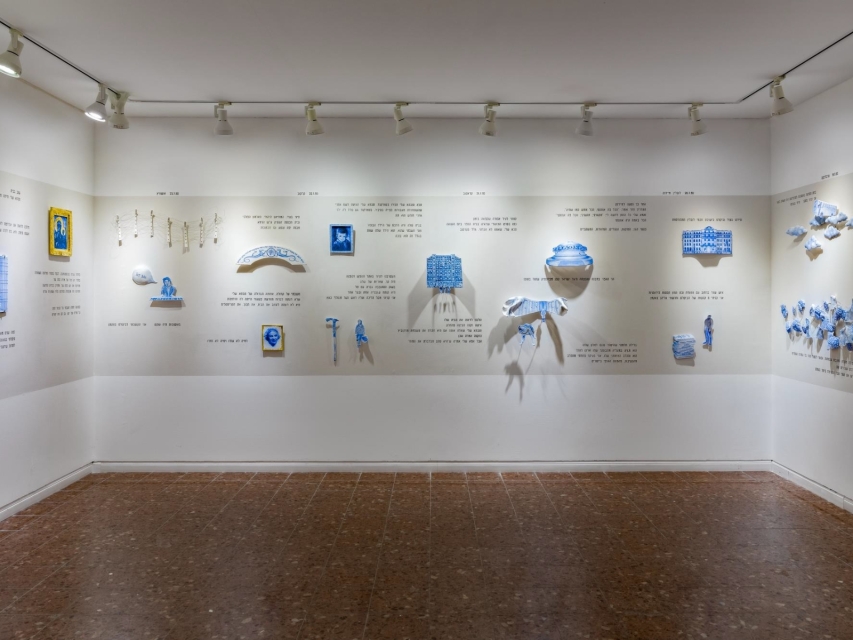
"Bonded Hearts Club" by Galia Armeland (born 1977 in Israel) is a new artwork in the POLIN Museum collection.
Copyrights
Galia Armeland, "Bonded Hearts Club". Fot. L. Gomon
Copyrights
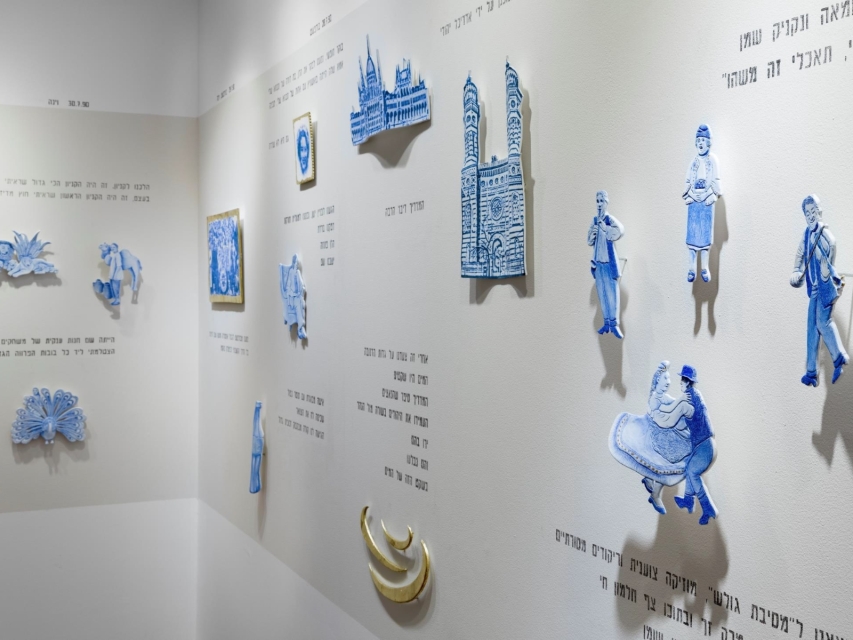
Galia Armeland, "Bonded Hearts Club". Fot. L. Gomon
Copyrights
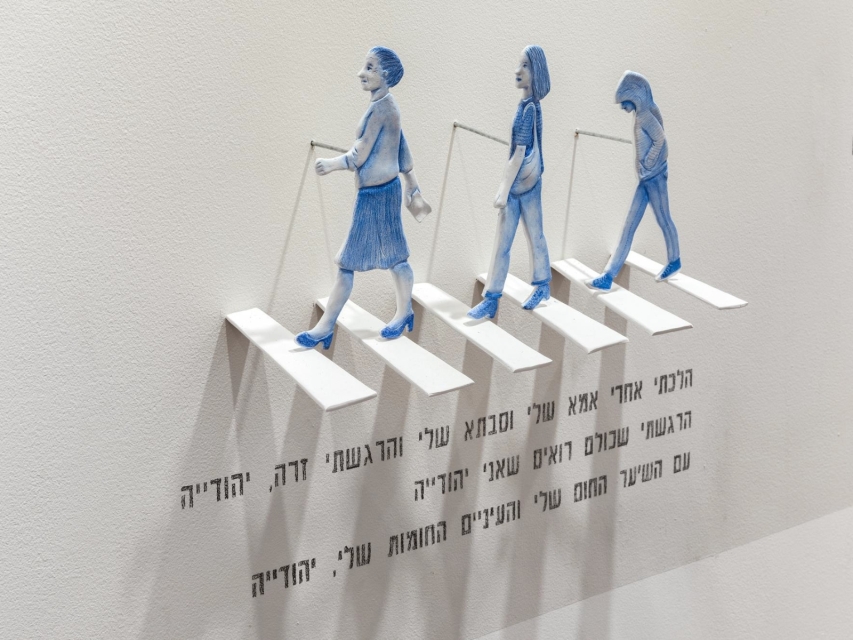
Galia Armeland, "Bonded Hearts Club". Fot. L. Gomon
This work is considered by the artist herself to be particularly valuable part of her oeuvre. It is closely linked to questions of identity and nationality, confronting us with the problem of passing the trauma of the Holocaust from one generation to the next, forcing the viewer to rethink the cruelty of war and its consequences for both survivors and their descendants.
The impetus for the installation was a trip to Holocaust sites in Poland, Austria, and Hungary, which Galia Armeland took as a teenager with her immediate family and a group of Holocaust survivors in 1990. The future artist was excited about her first trip abroad, but she found the journey to the Holocaust sites very difficult. It wasn't until many years later that the artist realised the impact it had on her, spurred on by another stay in Poland during a scholarship in Wrocław in 2018. When creating, she looked at the Holocaust through the eyes of an adult woman, recalling her childhood memories, but also through the eyes of her surviving grandmother and her mother born after the war, confronting the trauma of the Holocaust.
In an installation made of ceramics, drawing and text, the artist recreated the story of her unconventional 'Bat Mitzvah trip' (girls on such day usually receive many gifts, which can include trips, but these usually are not trips to Holocaust sites). In the installation, Armeland presents a kind of illustrated story, with a beginning and an end, following the itinerary described in the original brochure from the early 1990s. Viewers of the 'Bonded Hearts Club's' are invited to learn more about the story of author's family. It is a journey of women from three generations: the grandmother – Holocaust survivor, her daughter – Galia's mother, and the artist herself – granddaughter and daughter. Awareness of the Holocaust is present in their lives, imprinted on their personalities, as the trauma of the war was passed on from generation to generation.
The title of the installation 'Bonded Hearts Club' refers to the 1967 Beatles' classic album 'Sgt. Pepper's Lonely Hearts Club Band'. The group's music is the leitmotif of Galia Armeland's journey – back then, for a teeenage girl, it served as a kind of mental escape from the trauma that was being passed on.
This work was exhibited in the artist's solo exhibition at the Kibbutz Museum of Ghetto Fighters [Lohamei HaGeta'ot], the most important (next to Yad Vashem) Holocaust institution in Israel. The photographs of the installation are taken from this presentation, for which we thank the artist and the photographer, Lena Gomon.
Information about the artist
Galia Armeland, graphic designer, illustrator, sculptor and ceramicist, is a graduate of the ceramics and glass department of the Bezalel Academy of Arts and Design in Jerusalem (2001), and completed her second degree in art studies at the renowned St. Martin's College of Art and Design in London (2004). She has exhibited her work in Israel and abroad. She is a lecturer at the Bezalel Academy of Arts and Design, an art tutor, and a community activist.
During her studies, she worked as an illustrator and was involved in e.g., animation. Since graduation and subsequent return to Israel, she has written and illustrated many books. In addition, she created unique graphic designs, including the 'Homage to Humanity in the Family' postage stamp series.
Galia Armeland's ouevre is extremely diverse, with her work embedded in both European and Jewish culture. The artist has developed a personal expression over the years, combining ceramic work with writing and illustration. She uses a variety of techniques and technologies in her work, with clay and metal being her favourite and most commonly used materials. She uses the former medium to create vessels, plates, and sculptures, while with the second, she focuses on laser cut-outs made of metal plates.
The purchase of Galia Armeland's work was made possible with funds raised by the Association of the Jewish Historical Institute in Poland and with support from Elizabeth Szancer, William S. Paley Foundation, Inc., and Yael Ungar.