The Warsaw Philharmonic Choir was founded in 1953 under Zbigniew Soja. Later chorus masters have included Roman Kuklewicz (1955–1971), Józef Bok (1971–1974), Antoni Szaliński (1974–1978), and Henryk Wojnarowski (1978– 2016), and since January 2017, the post has been held by Bartosz Michałowski.
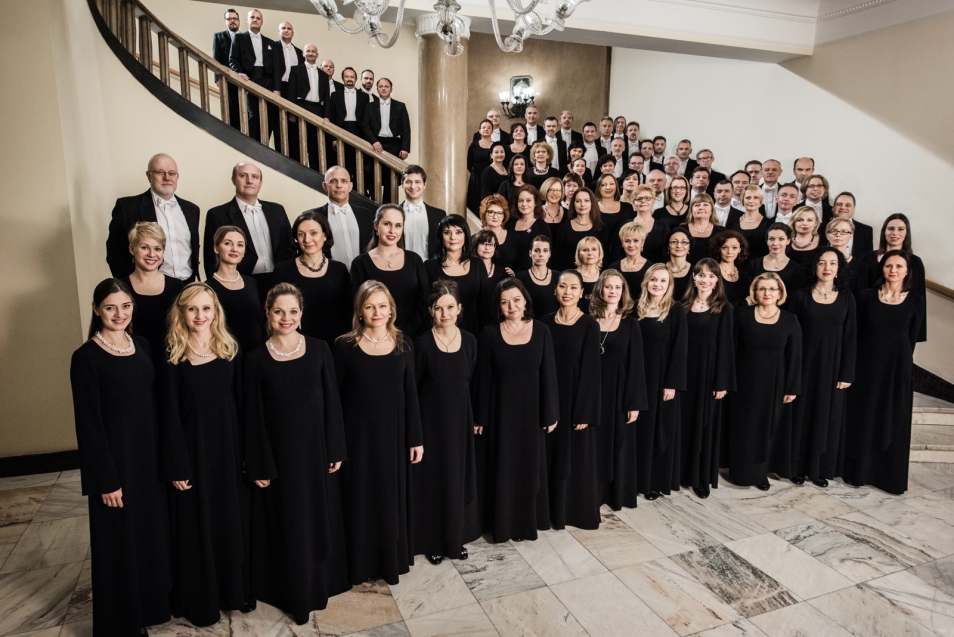
Copyrights
fot. Chór Filharmonii Narodowej
The choir’s performances focus around symphonic and oratorio concerts with the Warsaw Philharmonic Symphony Orchestra, as well as a capella per-formances in the Warsaw Philharmonic Hall. Each season, the Choir stages numerous concerts here, and also appears regularly at the Warsaw Autumn International Festival of Contemporary Music and the Wratislavia Cantans Festival. The Warsaw Philharmonic Choir has also performed extensively abroad, in Austria, Belgium, Denmark, Finland, Greece, Spain, Iceland, Israel, Germany, Russia, Switzerland, Turkey, Lithuania, Latvia, France, and Italy. In May 2015, it also toured Great Britain with the Warsaw Philharmonic Symphony Orchestra. The Choir has been frequently invited to perform in concerts with such outstanding orchestras as the Berlin and Munich Philharmonic, the Berlin Radio Symphony Orchestra, the RIAS Orchestra, the
Bamberger Symphoniker, the Tel Aviv and Jerusalem Symphony Orchestras, the Accademia Nazionale di Santa Cecilia Symphony Orchestra in Rome, the Brussels Opera Orchestra, the Palermo Symphony Orchestra, and the La Scala Orchestra in Milan.
In February 2017, the Choir received the most prestigious award of the phonographic industry, a Grammy, in the “Best Choral Performance” category, for the first CD in the Penderecki Conducts Penderecki series (featuring Dies Illa, Psalms of David, Hymn to St. Danill and Hymn to St. Adalbert). The Choir had been nominated for Grammy six times before this occasion – five times for its recordings of Krzysztof Penderecki’s works, i.e. St Luke Passion (two nominations: in 1991, directed by the composer, and in 2004, directed by Antoni Wit), Polish Requiem (2005), Symphony No. 7 “Seven Gates of Jerusalem” (2007), and Utrenja (2009), and also for an album featuring Karol Szymanowski’s Stabat Mater, Veni Creator, Litany to Virgin Mary, Demeter, Penthesilea (2008). The album with Polish Requiem also received the Record Academy Award 2005 (from the Japanese magazine Record Geijutsu).
In April 2009, the Choir’s album Stanisław Moniuszko – Masses Vol. 1 received a Fryderyk award, in the “Album of the Year – Choral and Oratorio Music” category, whilst Vol. 2 was honoured with a Golden Orpheus – Arturo Toscanini Award from the French L’Académie du Disque Lyrique, in the category “Best Phonographic Initiative” in May 2010. The latter was given in recognition of its promotion of Stanisław Moniuszko’s oeuvre.
These two CDs are the world’s only recording of Moniuszko’s complete masses. In March 2011, the Choir received a Fryderyk award of the Polish Phonographic Academy for its 1989 CD recording of Roman Maciejewski’s Requiem, which was reissued with a new graphic layout in 2010 to mark the 100th Anniversary of the composer’s birth. December 2014 saw the release of a DVD with Christmas carols, followed by a CD featuring the same repertoire in 2015.
The Choir’s discography also comprises Handel’s Messiah, Israel in Egypt and Juda Maccabaeus, Mozart’s Requiem, Beethoven’s Fidelio and Symphony No. 9, Verdi’s Requiem, Berlioz’s La Damnation de Faust, Bruckner’s Te Deum, Elsner’s Passion, Mahler’s Symphony No. 8, Moniuszko’s Litanies of Ostra Brama, Maklakiewicz’s Four Masses, Schumann’s Scenes from Goethe’s Faust, Bellini’s Norma, Wagner’s The Flying Dutchman, Kilar’s Missa pro pace, Brahm’s Ein Deutsches Requiem, Dvořák’s Requiem, and Weinberg’s Symphony No. 8 “Polish Flowers”.