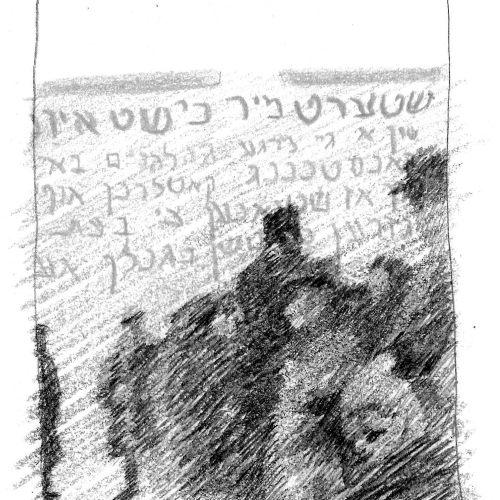
The conference will explore the historical, cultural, and political roles of Jewish languages—such as Yiddish, Hebrew, Ladino, and others—across different regions and time periods, with a particular focus on how these languages functioned in contexts of crisis, migration, and identity formation.

Yiddish writers at the Czernowitz Conference; from left to right: Abraham Reyzen, Yitschok Leybush Perets, Sholem Asch, Chaim Żytłowski, Hersh David Nomberg, 1908. Photo: YIVO Institute for Jewish Research, New York
Organizational information:
- Date, venue: 1–3 June 2026 (Monday–Wednesday ), POLIN Museum
- Conference language: English
- Keynote lecture language: English, with simultaneous translation into Polish
- Registration is mandatory. Register
- Recordings of the conference are available upon request to anyone interested. Please request the recording at [email protected]
- More information: [email protected]
Through a series of thematic panels and a keynote lecture, participants will examine topics including language use in wartime and displacement, multilingual interactions in Jewish communities, the ideological significance of language in Zionism and diaspora, and the evolution of Jewish cultural expression in literature, theater, and everyday life.
Program
Day 1, June 1, Monday
- 14:30–16:00 Opening. Panel 1. Jewish Languages in Dark Times
- Moderator: Hannah Pollin-Galay (University of Massachusetts, Amherst)
- Marc Volovici (University of Haifa): From German to Russian: Tainted Languages and Jewish Imperial Memory
- Shmuel Refael (Bar-Ilan University): Ladino in the Extermination Camps: Linguistic Transformation and a Survival Resource
- Ewa Spławska (Adam Mickiewicz University): Language as a Tool of Power: Bureaucracy, Citizenship, and Communication in the Zbąszyń Camp (1938–1939)
- 16:00–16:30 Coffee Break
- 16:30–18:00 Panel 2. The Many Faces of Yiddishism
- Moderator: Marek Tuszewicki (Jagiellonian University)
- Karolina Koprowska (Jagiellonian University): Practicing Doikayt: The Landkentnish Movement and the Production of Diasporic Locality
- Gil Ribak (University of Arizona): Enlisting Yiddish: The Allegedly Intrinsic Connection between Yiddish and Leftwing Jewish Politics in a Historical Perspective
- Eyshe Beirich (Columbia University): Race Science and the Origins of Yiddishism: The Case of Matisyohu Mieses
- Ellie Kelman (Brandeis University): Transforming the Yiddish-speaking Masses: A. Litvak’s Visionary Culturalism
- 18:00–18:30 Coffee Break
- 18:30–20:00 Keynote lecture
- Hannah Pollin-Galay (University of Massachusetts, Amherst): What the Holocaust did to Yiddish
Day 2, June 2, Tuesday
- 10:00–11:30 Panel 3. Jews in Multilingual Contexts
- Moderator: Sarah Bunin Benor (Hebrew Union College)
- Agnieszka Jeż (Jewish Historical Institute, Warsaw): Yiddish Language in Cultural Work in Zionist Youth Organizations in Interwar Poland
- Eugenia Prokop-Janiec (Jagiellonian University): Polish Language and Jewish Politics in Interwar Poland
- Sebastian Schulman (Yiddish Book Center): Brother Tongue: Esperanto and the Other Sutzkever
- 11:30–12:00 Coffee Break
- 12:00–13:30 Panel 4. Reimagining Hebrew
- Moderator: Ofer Dynes (Columbia University)
- Maciej Ratajczyk (Adam Mickiewicz University): Latinization of Hebrew and the Margins of Zionism
- Sharon Avni (Borough of Manhattan Community College, CUNY): What Hebrew Does: Language Ideology and the Making of the American Jewish Community
- Elazar Elhanan (CUNY Graduate Center): A Sort of Redemption? Translation as Resistance to the Negation of Diaspora
- 13:30–14:30 Lunch
- 14:30–16:00 Panel 5. Between Languages
- Moderator: Mateusz Majman (Ben Zvi Institute)
- David Guedj (Hebrew University): Multilingualism and Ideology: The Linguistic World of Moroccan Jewry in the Modern Era
- Hila Shalem Baharad (Tel Aviv University): “Our Own Kind of Hebrew”: Linguistic Mediation in the Maʿabarot, Israel’s Transit Camps
- Alisa Abramov (Bar-Ilan University): Between Juhuri and Hebrew: Cultural Autonomy and Language Struggle Among Northeast Caucasus Jews under Soviet Rule, 1920–1925
- Emil Kerenji (United States Holocaust Memorial Museum): Serbo-Croatian as the Language of Yugoslav Zionism: Jewish Press in the Western Balkans, 1896–1941
- 16:00–16:30 Coffee Break
- 16:30–18:00 Panel 6. Mapping Global Yiddish Culture
- Moderator: Magdalena Kozlowska (University of Warsaw)
- Ernesto Mifano Honigsberg (University of São Paulo): Yiddish Art and Resistance in São Paulo: Language, Memory, and Diasporic Creativity in the 20th Century
- Agata Dąbrowska (University of Łódź), Jakub Parnes (University of Economics in Katowice): From “Jargon” to Cultural Authority: The Reframing of Yiddish in the Australian Jewish Diaspora (1933–1973)
- Yael Levi (Hebrew University): Yiddish Voices from the Maghreb: Moshe Dluznowsky and Yiddish Literature in Morocco
- Susy Gruss (Bar-Ilan University): From Hebrew and Yiddish to Judeo-Spanish: Literary Reflections and Resonances
Day 3, June 3, Wednesday
- 9:30–11:00 Panel 7. Making of Ultra-Orthodox Identity in the Modern Era
- Moderator: Daniel Reiser (Herzog College)
- Chaya R. Nove (Fordham University): The Writing on the Wall: Yiddish Signage and the Semiotics of Hasidic Belonging in Suburban New York
- Shira Freed (Hebrew University): Linguistic Policy and Ideological Insulation in the Bais Yaakov School System of Interwar Poland
- Kalman Weiser (York University): “The Fallenness of haredi Folk”: Solomon Birnbaum’s Relationship to the Bais Yaakov Schools
- 11:00–11:30 Coffee Break
- 11:30–12:45 Panel 8. Languages on Stage
- Moderator: Sonia Gollance (University College London)
- Anna Nienartowicz-Wojsławska (University of Wrocław): The Stage as a Field of Power: Legitimizing and Developing Yiddish through the Professional Theater in Warsaw (1905–1939)
- Marcos Silber (University of Haifa): On Scene, Off Scene, Unseen: Entangled Stages and Denied Connections in Polish, Yiddish, Hebrew Interwar Literary Cabaret
- Rachel Merrill Moss (University of Texas): Yiddish on Stage, Polish in the Headset: Postwar Yiddish Performances in Poland and the Phenomenon of Simultaneous Translation
Conference Accessibility
Conference Room A
- Step-free Access: The room has no thresholds or architectural barriers.
- Getting There: Accessible via stairs or elevator. Stairs feature high-contrast markings and handrails with Braille descriptions.
- Hearing Support: The room is equipped with an individual induction loop system.
- Sensory Support: Noise-cancelling headphones can be borrowed for free at the Information Desk (Level 0).
- Restrooms: An accessible restroom is located on Level 0. It is equipped with a call system, a changing table, and tactile/Braille signage.
Steering committee:
- Prof. Sarah Bunin Benor (Hebrew Union College)
- Prof. Nathan Cohen (Bar-Ilan University)
- Prof. Ofer Dynes (Columbia University)
- Prof. Sonia Gollance (University College London)
- Dr. Aleksandra Jakubczak (POLIN Museum)
- Prof. Joanna Nalewajko-Kulikov (Polish Academy of Sciences)
- Dr. Marek Szajda (POLIN Museum)
- Dr. Marek Tuszewicki (Jagiellonian University)
- Dr. Agnieszka Żółkiewska (The Emanuel Ringelblum Jewish Historical Institute)
Partners:


The conference is organized within the Global Education Outreach Program.
The conference is made possible with support from Taube Philanthropies, William K. Bowes, Jr. Foundation, Libitzky Family Foundation and the Association of the Jewish Historical Institute of Poland.

The conference is made possible thanks to the financial support of Bar-Ilan University
International conference "Jewish Languages and Politics. Ideological Choices of Jews in the Modern Era"
01.06.2026 - 03.06.2026